



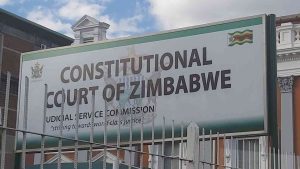
Former Citizens Coalition for Change (CCC) lawmaker Prince Dubeko Sibanda has filed an urgent application in the Constitutional Court of Zimbabwe seeking to stop Parliament from processing two clauses in the Constitution of Zimbabwe Amendment (No. 3) Bill, 2026.
Sibanda, a lawyer and former MP for Binga North, argues that the clauses are designed to extend the terms of current office-holders in violation of the country’s supreme law. Sibanda filed the application on 10 March 2026.
He is being represented by the Harare law firm Mbidzo Muchadehama & Makoni.
The application targets two provisions of the Bill – Clause 4(b), which deals with the presidential term, and Clause 9(b), which deals with the duration of Parliament.
Both clauses include identical wording stating that their term-extension effects will apply “notwithstanding section 328(7)” of the Constitution.
Section 328(7) clearly states that any amendment extending the length of time a person may hold public office cannot apply to anyone who already holds that office, or an equivalent one, before the amendment is made.
In Sibanda’s argument, this provision serves as the Constitution’s safeguard against incumbents extending their own time in office. In his founding affidavit, Sibanda wrote:
“The Bill the Respondent published in readiness of the process of constitutional amendment nevertheless contains provisions that purport to operate ‘notwithstanding section 328(7)’, and to apply term-extension effects to the continuation in office of incumbents.
“This is not a mere interpretive disagreement. It is an explicit legislative declaration that the Respondent intends to do what s 328(7) of the Constitution forbids.”
The Bill proposes replacing the current five-year presidential and parliamentary terms with a seven-year term.
It also seeks to apply the change not only to future office-holders but to those currently in office, using the contested “notwithstanding” wording.
Sibanda argues that this amounts to a direct attack on Zimbabwe’s constitutional order, rather than simply a debate over how long terms of office should be.
He said he is not asking the court to rule on whether any particular term length is appropriate. Said Sibanda:
“I do not ask this court to decide the wisdom, popularity, or political desirability of any constitutional change. I ask the court to enforce a purely legal boundary.”
The constitutional limit Sibanda relies on is section 328, which he says is not simply a procedural checklist but the legal framework that both creates and restricts Parliament’s power to amend the Constitution.
He argues that a clause designed to override that framework is not a legitimate use of the amendment power, but an attempt to sidestep it.
Sibanda also warns of the wider risks of allowing such drafting. He argues that if Parliament can bypass section 328(7) by inserting the word “notwithstanding”, it could set a dangerous precedent.
In future, he says, a Bill could declare “notwithstanding section 328(5)” in order to pass a constitutional amendment by a simple majority instead of the required two-thirds vote.
The application also questions the timing of Parliament’s actions. Sibanda argues that the harm does not only arise when a Bill is passed, but from the moment a constitutionally flawed Bill enters the legislative process.
He says publishing and advancing such a Bill is itself inconsistent with Parliament’s obligations under sections 119 and 324 of the Constitution, which require the legislature to protect the Constitution and carry out its duties diligently.
However, the relief Sibanda is seeking is narrowly focused. He is not asking the court to stop the entire Bill, but only to remove Clauses 4(b) and 9(b) and declare them invalid, allowing the rest of the Bill – including any constitutionally valid term proposals – to proceed.
The draft order asks the court to declare the two clauses inconsistent with section 328(7) and direct Parliament either to withdraw and reintroduce the Bill without them or to continue with the clauses treated as removed.
Parliament has 21 days from the date it is served with the application to file a notice of opposition and supporting affidavits. If it does not respond, the case will proceed as unopposed.
More: ZimLive

 Pindula WhatsApp Channel
 Facebook Page


Leave a Reply