






One month after the RIDA Mbuya Nehanda ferry capsized on Lake Kariba, killing at least 97 people, it has emerged that the vessel should never have been on the water and was grossly overloaded.
As reported by Pachena, engineers had written to the government beforehand, warning that the ferry required structural work to improve its stability.
The ferry capsized amid high waves on 11 August 2026. Kariba Lake Captain Adam Nyekete confirmed receiving the engineers’ warnings during a meeting with Transport and Infrastructural Development Minister Felix Mhona on 16 August 2026.
Despite this, the government has placed sole responsibility for the tragedy on the late Mbuya Nehanda captain, Sign Patsikadova.
Local Government and Public Works Minister Daniel Garwe claimed Patsikadova had ignored adverse weather warnings and set sail regardless, and insisted the ferry had been certified fit for service by the Ministry of Transport and Infrastructural Development.
Boat operators also said strong winds and waves were coming from the direction of Binga at the time, and that the Lake Captain had advised operators to stay off the water.
However, an investigation by Pachena found that the Mbuya Nehanda had a long history of mechanical, structural and operational problems — many of them known to officials, boat operators and regular users of the ferry well before it sank.
The Mbuya Nehanda (KF551) was operated by the state-owned Rural Infrastructure Development Agency (RIDA), which falls under the Office of the President and Cabinet (OPC).
The vessel served as a crucial means of transport for villagers, fishermen, traders, teachers and nurses living in Kariba’s remote areas, offering a route that was both shorter and cheaper than travelling by road.
The crossing from Kariba to Mola, for example, took six to seven hours and cost around US$15 by ferry, compared with up to two days and US$30 by road.
The vessel was also overloaded at the time it capsized. The government says the ferry had an approved capacity of 95 passengers and crew, but it was carrying at least 174 people when it went down.
Police have confirmed that 97 bodies have been recovered and 77 people rescued, though the exact number who were on board has yet to be established.
In an initial statement issued hours after the disaster, police said the ferry had been carrying 90 passengers and five crew members.
However, the number of bodies recovered and survivors rescued since indicates that at least 174 people, along with heavy cargo, were on board when the ferry capsized.
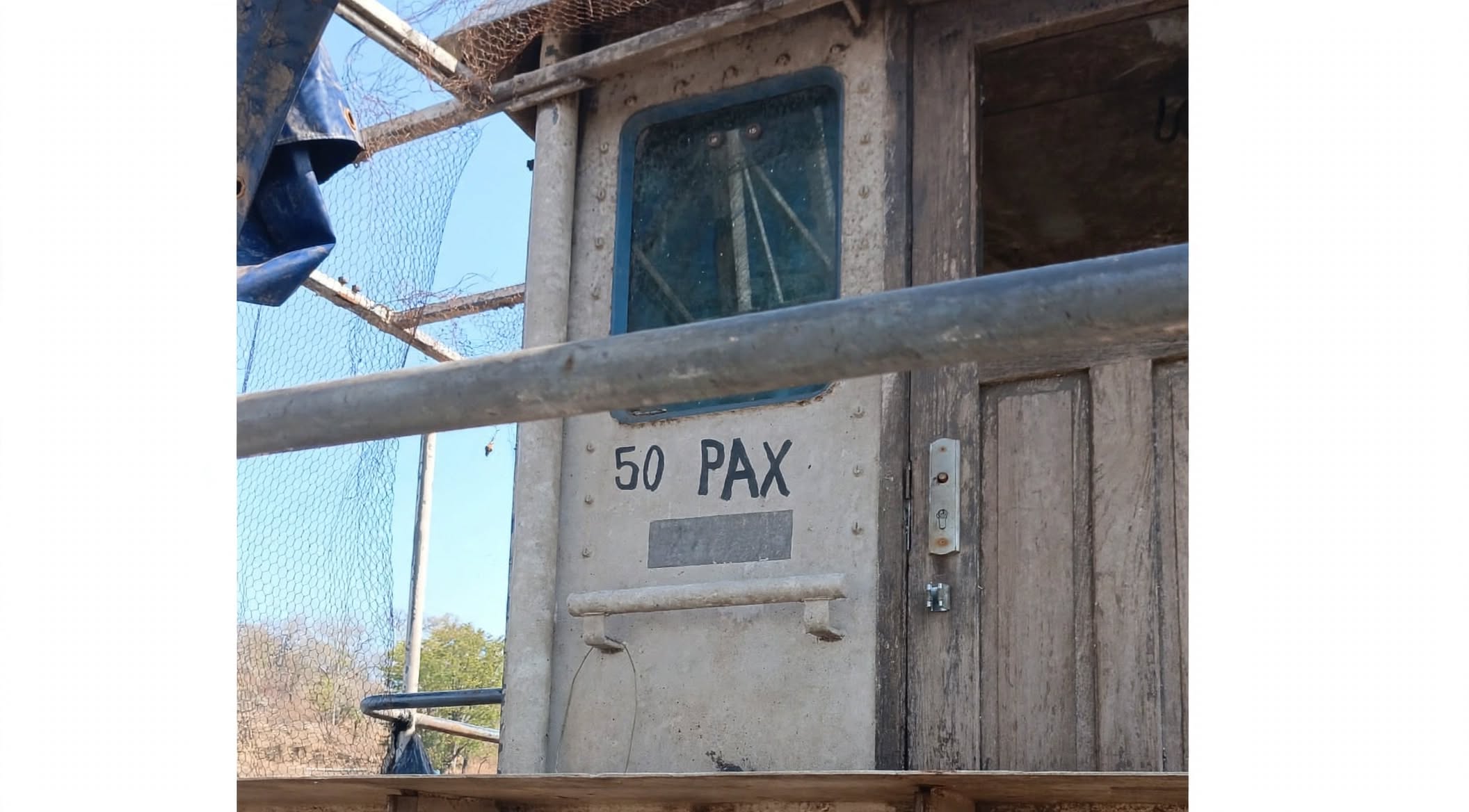
Sources in Kariba’s tourism industry told Pachena that the ferry’s original capacity of 95 had been reduced to 50 after its engines failed in 2024.
The vessel had nearly capsized once before, in December 2024, shortly after leaving Peters Point, a harbour and ferry terminal on the lake’s southern shore.
When the wreck was pulled ashore on 25 August 2026, it was marked “50 PAX” (passengers) — appearing to confirm that its capacity had indeed been reduced.
Pachena established that engineers from KB Engineering, who serviced the ferry, repeatedly wrote to Lake Captain Nyekete and RIDA outlining the work needed to stabilise the vessel. Their central recommendation was that two additional pontoons should be fitted.
These warnings came to light on 16 August, when Minister Mhona held a closed-door, fact-finding meeting with boat operators and other stakeholders at Pat McLean Hall in Kariba Heights, urging attendees to speak freely about the causes of the accident.
Cephas Shonhiwa, administrator of the Kariba Business and Tourism Indaba — a travel association representing 141 member companies operating between Binga upstream and Kanyemba downstream — told the minister that the ferry had not been fit for purpose.
Shonhiwa said he had contacted the engineers who had worked on the Mbuya Nehanda after claims about its servicing history surfaced on social media.
The engineers confirmed they had written to the Lake Captain on several occasions, listing the work required to make the vessel safe, including the fitting of two additional pontoons.
After Shonhiwa spoke, the minister turned to the Lake Captain and asked him to confirm receipt of the letters. Nyekete confirmed that he had received them.
When Pachena later contacted Nyekete directly, he declined to comment, saying: “I am not allowed to speak to the media. I am a junior civil servant. You need to speak to my director.”
As Lake Captain, Nyekete holds a senior position within the Ministry of Transport and Infrastructural Development’s Department of Inland Waters Control, responsible for safety enforcement — including ensuring that all vessels, from houseboats to ferries such as the Mbuya Nehanda, comply with the Inland Waters Shipping Act. This covers checks on seaworthiness and safety equipment, including life jackets, fire extinguishers and communication radios.
Shonhiwa confirmed to Pachena that he had told the minister the ferry was not fit for service.
“What I said in the meeting is that our engineers, KB Engineering (Pvt) Ltd, made known to RIDA and the Lake Captain that for the Mbuya Nehanda to carry people at full capacity, it needed proper buoyancy and stability while navigating,” he said.
Minister Mhona confirmed that the closed-door meeting had taken place but declined to disclose further details.
“Government has directed there be an inquiry, and I think let us be guided by this process,” he told Pachena.
Pachena also contacted Keith Baleyntine, director of KB Engineering, to verify the work his company had carried out on the vessel. He was evasive, saying only: “There is a board of enquiry set up. I can’t speak about that,” before ending the call.
Acting RIDA District Head for Kariba, Ignatius Chiome, who also attended the meeting, said he was not authorised to comment “on anything regarding that issue.”
Chiome has since been arrested on culpable homicide charges in connection with the incident. He appeared in court on 26 August and is currently out on bail.
Zimbabwe’s Director of Inland Waters Control, Lameck Chitenga, confirmed to Pachena that Shonhiwa had raised the engineers’ written concerns about the vessel’s defects during the meeting.
“The Lake Captain [Nyekete] told the minister during the meeting in Kariba that he had seen the letter from engineers warning that the mechanical fitness of the Mbuya Nehanda needed to be improved,” said Chitenga.
“However, even though the Lake Captain confirmed he saw the letter, I am yet to receive it. Maybe they will send me a copy.”
Despite this, Chitenga said he disagreed with the engineers’ assessment.
“Mr Shonhiwa said the engineers who refurbished the Mbuya Nehanda recommended that two additional pontoons be fitted to improve its flotation,” he said.
“However, I do not agree with this version. I say so because the vessel, even up to now, has not sunk completely in the lake — it is still floating.”
Chitenga instead pointed to possible navigational error by the deceased captain.
“The Mbuya Nehanda has been operating since 1985 and has never encountered a problem,” he said. “I want to believe that the vessel capsized because of a navigational error by the deceased captain. It could be that the captain wrongly entered a wave, and it hit the boat on its side. The wave must not hit the boat sideways.”
He added that the captain should have “entered the wave directly, or ensured it was always on the back of the vessel,” and that full details would only emerge once the ongoing investigation concluded.
As Director of Inland Waters Control, Chitenga is primarily responsible for the safety, regulation and administration of Zimbabwe’s navigable waterways, including safety surveys and inspections to ensure vessels are seaworthy and properly equipped.
RIDA Director General Christopher Shumba maintained that the ferry was seaworthy and dismissed the engineers’ recommendations as mere “speculation.”
He, however, acknowledged that the ferry had experienced engine problems in the past, but said these had since been rectified.





Leave a Reply Cancel reply