



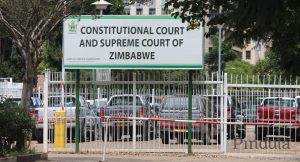
The Constitutional Court has dismissed an application by two citizens seeking direct access to challenge the constitutionality of a ZANU PF conference resolution they claimed sought to extend President Mnangagwa’s tenure beyond the constitutional limit.
The application was brought by Moreprecision Muzadzi and Pardon Gambakwe.
In a unanimous judgment delivered by Deputy Chief Justice Paddington Garwe, with Justices Ben Hlatshwayo and Bharat Patel concurring, the court ruled that the applicants had failed to show that it was in the interests of justice for the matter to be heard by the Constitutional Court as a court of first instance.
The pair had sought leave under Section 167(5) of the Constitution to bring substantive constitutional proceedings, arguing that a resolution adopted at the ZANU PF National People’s Conference in Mutare in October 2025 threatened citizens’ political rights by seeking to extend the President’s term from five years to seven.
They argued the resolution violated constitutional provisions guaranteeing regular elections and limiting presidential tenure, and alleged that President Mnangagwa had acted inconsistently with his constitutional oath by failing to repudiate it.
The court, however, held that the application was procedurally defective and did not comply with the Constitutional Court Rules governing applications for direct access.
Justice Garwe said the applicants had not properly pleaded the legal and factual basis for bypassing the High Court, which has concurrent jurisdiction in constitutional matters.
The court also found that the dispute was not ripe for determination, as no Constitutional Amendment Bill proposing changes to presidential term limits had been tabled in Parliament.
The alleged infringement, the Deputy Chief Justice said, remained speculative and dependent on uncertain future legislative steps.
The court reaffirmed the doctrine of constitutional avoidance, holding that courts should not decide abstract or hypothetical constitutional questions before they have crystallised into concrete disputes.
Premature intervention, it said, would risk intruding into matters that fall within the constitutional domain of Parliament and the Executive.
Direct access to the Constitutional Court, the court ruled, is an extraordinary remedy reserved for exceptional cases where the interests of justice require bypassing lower courts.
Having found that the applicants had failed to meet the procedural requirements for direct access and to establish a ripe constitutional dispute, the court dismissed Muzadzi and Gambakwe’s application.
More: The Herald

 Pindula WhatsApp Channel
 Facebook Page


Leave a Reply