

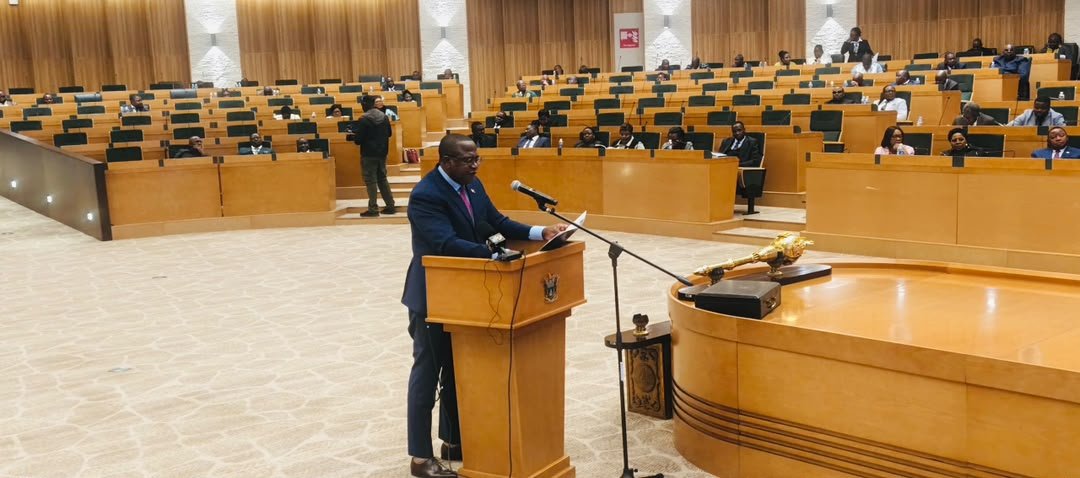

The Ministry of Finance, Economic Development and Investment Promotion has dismissed reports that the Office of the President and Cabinet (OPC) has overspent its budget, saying the 143 per cent utilisation reported in the Mid-Term Budget Review reflects centrally managed national programmes.
Finance Minister Mthuli Ncube on Friday, 31 July, said his ministry had noted public interest in the Budget Utilisation Report presented as part of the 2026 Mid-Term Budget and Economic Review Statement, particularly the reported 143 per cent budget utilisation under the OPC vote as of 30 June 2026.
“The Ministry wishes to clarify that this does not constitute operational expenditure by the Office of the President and Cabinet, nor does it constitute unauthorised expenditure or a budget overrun by the Office,” Ncube said.
He claimed that the figure reflects Government’s deliberate approach to centrally managing selected strategic national programmes and projects through the OPC.
“This arrangement enables the Government to coordinate the implementation of cross-cutting programmes, accelerate project execution, strengthen oversight, and achieve greater efficiency in the utilisation of public resources across Ministries, Departments, and Agencies (MDAs),” Ncube said.
He said the expenditure aligns with strategic national priorities that benefit multiple sectors of Government, namely: refurbishing and upgrading hospitals, implementing national social protection programmes, interventions supporting the education and agricultural sectors, digital economy projects as well as centralised capacitation of Government departments and other critical development initiatives.
Ncube asserted that the centralised implementation enables Government to improve coordination, optimise resource allocation and ensure timely delivery of priority national projects.
“Accordingly, expenditure incurred under these centrally managed programmes is initially recorded under the Vote of the Office of the President and Cabinet and then reallocated to the respective beneficiary Ministries, Departments, and Agencies through the appropriate budgetary and accounting processes,” Ncube said.
Ncube reiterated that Government remains firmly committed to fiscal discipline, transparency and accountability in the management of public resources.
“All expenditure is undertaken within the framework of the Constitution of Zimbabwe, the Public Finance Management Act and the Appropriation Act, and remains subject to Treasury oversight, internal controls, audit and Parliamentary scrutiny,” the statement said.
The Treasury chief said the Mid-Term Review itself demonstrates continued commitment to prudent fiscal management.
In the first half of 2026, he said, total revenue totalled ZiG137.8 billion, while total expenditure and net lending totalled ZiG123.6 billion, resulting in a budget surplus of ZiG14.2 billion.
Ncube urged members of the public, the media and all stakeholders to interpret the reported budget utilisation under the OPC vote within the broader context of Government’s budget execution and public financial management processes.
“The reported expenditure should not be construed as expenditure solely attributable to the operations of the Office of the President and Cabinet, but rather as expenditure related to centrally managed national programmes that will, in due course, be reallocated to the respective beneficiary Ministries, Departments and Agencies,” Ncube said.
He said reference to a “spending spree” in some media reports was “therefore inaccurate and misleading, if not mischievous, and was never mentioned in the Minister of Finance’s Statement.”
“The Ministry remains committed to upholding the principles of sound public financial management and to providing timely, accurate, and transparent information on the management of public resources,” Ncube said.

 Pindula WhatsApp Channel
 Facebook Page


Leave a Reply