



Lawyers for convicted business partners Mike Chimombe and Moses Mpofu have confirmed they plan to take their case to the Supreme Court, challenging both the convictions and the sentences. They argue that the High Court made errors in its ruling.
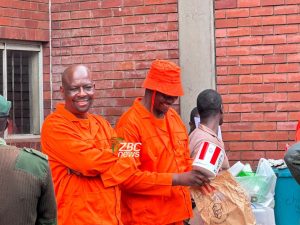
On Monday, 8 December, the High Court sentenced Mpofu to 22 years and Chimombe to 17 years for defrauding the government of US$7.7 million under the Presidential Goat Pass-on Scheme, which was intended to provide goats to vulnerable rural households.
After suspensions and conditions for restitution were applied, Mpofu will serve an effective 15 years, while Chimombe faces 12 years in prison.
Speaking to journalists after the sentencing, Mpofu’s lawyer, Tapson Dzvetero, said they were dissatisfied with both the conviction and the sentences, and expressed hope that the Supreme Court would overturn the decision. Said Dzvetero:
“We are going to the Supreme Court. Our clients think that the superior court will come to a different decision.
“Our clients believe that the court grossly misdirected itself in its findings, from both the conviction and the sentences, so we have to hear what the Supreme Court says.
“We are challenging the conviction that the court has found that there was a fraud perpetrated by a fictitious person.
“Our clients feel that the judgment itself is contradictory. They do not understand the basis upon which the conviction is built, particularly because this relates to an existing company.”
He said both Chimombe and Mpofu were “aggrieved” by what they view as inconsistent reasoning in the ruling, arguing that the company allegedly used in the fraud was legitimate and could not justify the court’s conclusion.
The court ruled that the two men used forged documents to secure a government tender to supply 632,001 goats under a livestock pass-on programme, worth US$87,757.16.
Although the tender was originally awarded to Blackdeck Private Limited, the contract was ultimately signed by an unregistered entity, Blackdeck Livestock and Poultry Farming, with the Ministry of Lands, Agriculture, Water, Fisheries and Rural Development.
The programme was aimed at helping vulnerable groups such as orphans, widows, the elderly, the disabled, and the chronically ill, as identified through a Ministry of Public Service database.
Investigations later revealed that the company didn’t have a valid 2021 tax clearance certificate, and a QR code on its NSSA compliance document was traced to a completely different firm, Skywalk Investments.
More: NewZimbabwe.com

 Pindula WhatsApp Channel
 Facebook Page


Leave a Reply