



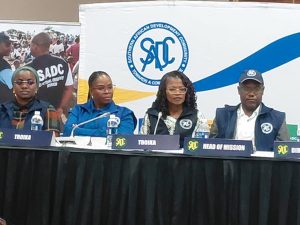
The SADC Election Observation Mission (SEOM) has said that Tanzania’s election, held last Wednesday, failed to meet regional standards for democratic polls.
In its preliminary statement released on Monday, 03 November, the Head of Mission, Richard Msowoya, outlined a series of irregularities and restrictions that, according to SEOM, undermined the credibility of the vote.
These included intimidation of opposition parties, restrictions on freedom of expression, reports of opposition agents being denied access to polling stations, and instances where observers noted “multiple orderly stacked ballots” in ballot boxes during voting — creating perceptions of ballot stuffing.
The mission also cited disruptions caused by an internet shutdown, which hindered the work of observers.
Incumbent President Samia Suluhu Hassan was declared the winner with 97.66 per cent of the vote after her main rivals were barred from contesting. The SEOM report reads in part:
“Despite carrying their Accreditation Identification Cards, our observers in Tanga Town were subjected to aggressive interrogation by the security forces, had their official documents, including their passports, seized, though later returned, and were forced to delete mission-related photographs from their official gadgets.”
The SEOM reported that the country was largely calm and peaceful throughout the pre-election period and election day, apart from a few isolated incidents near the end of voting. It added:
“However, a few stakeholders cautioned that the general calm and peace belies covert acts of general intimidation of the population and opposition political parties and candidates. These stakeholders cited the alleged abductions of some political activists.
“They also described a tense and intimidating political atmosphere. The stakeholders highlighted the arrest of members of the opposition, notably the detention and trial of Tundu Lissu, the leader of the main opposition party, Chama cha Demokrasia na Maendeleo (CHADEMA), on treason charges.
“The disqualification of some opposition candidates, particularly of Mr. Luhaga Mpina of ACTWazalendo also raised questions about the fairness of the electoral landscape, especially on the mainland.
“Some stakeholders viewed the arrests and disqualification as undermining the URT’s multi-party system by removing legitimate competition in the electoral process.
“This appears to create an uneven political playing field, which in turn also discourages public participation and voter turnout.”
Regarding Tanzanian voters’ freedom of expression, the SEOM observed that restricted access to certain social media platforms may have hindered citizens’ ability to exchange political opinions. It said:
“Some stakeholders also highlighted that the private media outlets were self-censoring due to fears of losing their licences should their coverage of election issues be deemed unacceptable by the Government.
“They informed the Mission that the media space was more restricted than it was during the previous elections.”
The SADC Mission reported that the internet shutdown hindered their ability to collect comprehensive data on the opening and voting processes. It said:
“The Mission was able to observe the opening of polls in some polling stations but could not generate all data relating to opening and voting processes as a result of an internet outage around midday.
“Due to protests in some areas and continued lack of internet connectivity, our Mission could not observe the closing and counting processes in most of the areas.
“Where we observed such processes, we could not generate data due to internet connectivity challenges.”
The Mission observed that in certain polling stations, party agents, though present, were prevented from entering to monitor the opening procedures.
The Mission also noted that in 93% of the polling stations observed, ballot boxes were adequately locked and sealed before voting commenced.
However, in some stations, ballot boxes had only a single seal instead of the required two, and a few appeared loosely sealed, giving the impression they could be easily opened. Reads the report:
“The Mission noted a very low voter turnout in all polling stations observed. Some polling centres did not have voters at all;
“The Mission observed that in some polling stations observed, there were multiple orderly stacked ballots in the ballot box during voting, which created a perception of ballot stuffing, and an impression that individual(s) cast more than one vote at a time with the intention to cheat the election system;
“The Mission could not generate polling, closing and counting statistics due to internet shutdown that negatively impacted the use of the SEOM system used to generate data;
“Most of our observers could not observe closing and counting due to incidents and threats of violence in some areas; and
“The Mission did not observe the presence of domestic observers in most of the polling stations.”
 Pindula WhatsApp Channel
 Facebook Page


Leave a Reply