

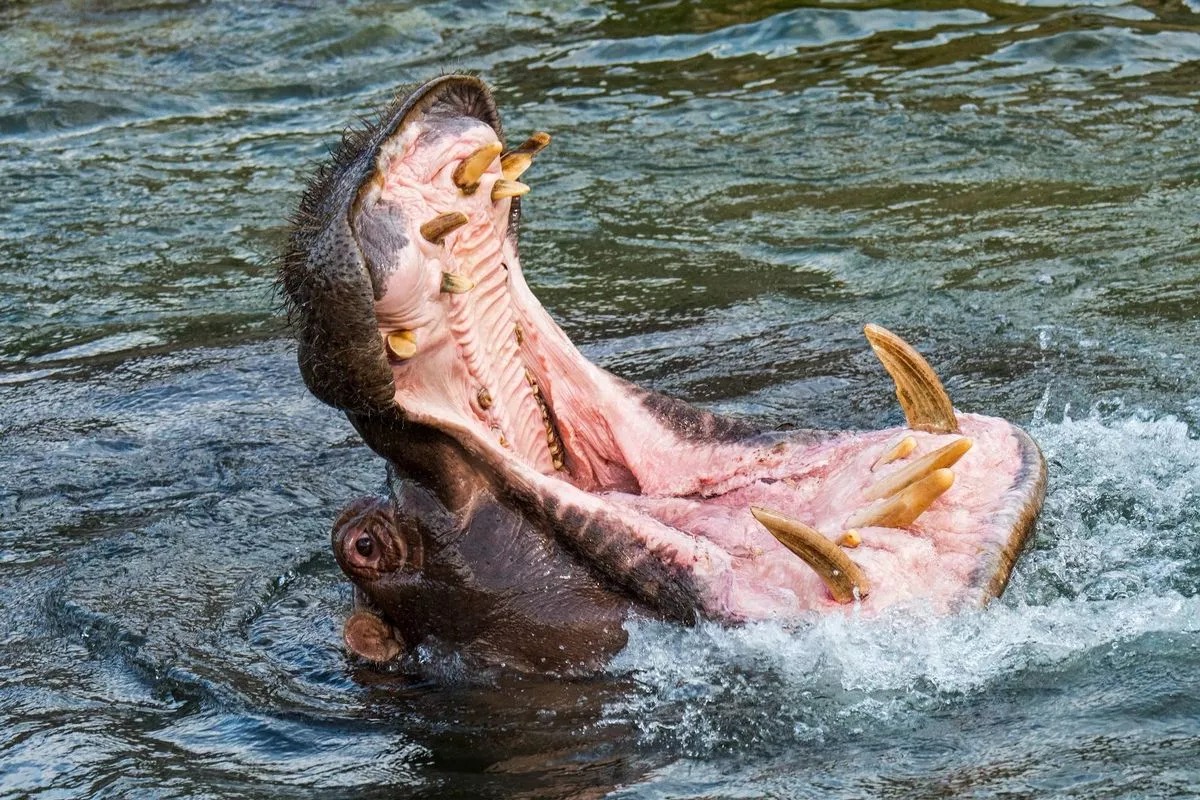

A safari tour guide who survived a vicious attack by a 15-foot hippopotamus has spoken about the surreal sense of calm he experienced during what he described as a near-death ordeal.
Paul Templer, who had worked as a safari guide for around six years, was leading a canoe expedition on the Zambezi River in Zimbabwe when the incident occurred.
He said that while he had encountered several close calls with wildlife over the years, nothing could have prepared him for the sheer force and ferocity of the hippo.
Templer recounted how the animal launched a surprise attack, pulling him underwater and clamping its massive jaws around his torso.
Despite the terrifying circumstances, he recalled feeling a strange moment of clarity and acceptance as the attack unfolded.
The experienced guide also revealed that he had previously been charged by both an elephant and a lion during his career, brushes with death that, in hindsight, did little to prepare him for the brutal hippo encounter. He recalled:
One day I was in a kayak, a little one man canoe, and I’ve been attacked by a really large crocodile that had me in its mouth and was like shaking me around.
However, the most life-threatening encounter came with what experts widely regard as one of the most dangerous land animals—responsible for more human deaths than lions. Speaking on the What It Was Like podcast, Paul said:
A fully grown bull hippo might grow to be 15 feet long, maybe 5 feet tall and weigh up to, say, 8,000 pounds.
I remember I used to drive a Land Rover, and that would make a fully grown bull hippo about the same length and weigh about twice what my Land Rover did. So that gives you some idea of how solid they can be.
Paul had originally been assigned a different task that day, but when a colleague fell ill and management asked him to lead a tour group to the scenic Victoria Falls, he eagerly accepted the opportunity.
As the canoes approached a group of hippos, Paul steered his tour into shallower waters, hoping to reduce the risk of the massive animals capsizing their boats.
His co-worker, Evans Namasango, was accompanying two tourists in a separate canoe but drifted away from the main group.
At first, Paul wasn’t overly concerned and took the chance to relax and enjoy the picturesque surroundings as he waited for Evans to catch up. He recalled:
And as I put my paddle down to just soak in the ambiance, there was just this, this crash. Unfortunately, I knew exactly what that sound was, having been around, it was the sound of a hippo hitting a canoe.
I turned just in time to see Evans’ canoe up in the air, with a hippo underneath the back of it. And Evans, the paddler, flying through the air.
Paul decided to turn back and try to rescue his fellow guide, but the massive hippo quickly shifted its focus to him.
Within seconds, he was dragged underwater. Disoriented and overwhelmed, Paul lost all sense of direction in the chaos beneath the surface. He explained:
I’m pinned inside something, and I’m trying to get around it, and I’m struggling to break free, and I can’t, but I managed to get one hand free.
And feeling around, I just felt the bristles on the hippo’s snout. So, at least now, I knew where I was. I was from my waist up, head first down a hippo’s throat.
Amid the chaos, Paul experienced an unexpected feeling—relief. His initial fear was that he’d been swallowed by a crocodile, an animal he admitted terrified him more than any other.
But he soon realised it was a hippo—and he was too large to be eaten. The hippo spat him out.
Struggling to the surface, Paul spotted his colleague Evans nearby, clearly in shock. Determined to help, he swam toward him.
As he moved in to perform a lifesaver’s hold, he was hit again—from below. This time, the hippo swallowed him feet first, up to the waist.
The violent thrashing prevented Paul from reaching his .357 magnum revolver, leaving him powerless.
He briefly escaped, but just as he surfaced, the hippo charged again. It struck him with full force, its tusks tearing through his torso.
Paul’s knees and legs hung outside one side of the beast’s mouth, while his head, shoulders, and arms were outside the other.
The attack left him with 38 serious injuries, including a traumatic degloving injury that stripped the flesh from his left arm.
A tourist who witnessed the attack described it as watching a vicious dog trying to rip apart a rag doll.
As he was held captive in the hippo’s enormous jaws, Paul experienced an odd sense of tranquillity. He said:
I’m lying at the bottom of the river. I’m lying wedged inside this hippo’s mouth.
His tusks are boring through me. And I’m staring up, and I can see the different hues of green and yellow. And I can see the sunlight shimmering on the water surface there.
And I remember thinking, ‘I wonder who can hold their breath the longest?’ And just being very matter of fact.
And then watching as my blood was just mingling with the water, and thinking ‘Am I going to bleed to death?
Fortunately, Mike, one of Paul’s fellow guides, managed to rescue him. Paul’s left arm was crushed beyond repair—bone was visible in every direction, and from the elbow down, the arm had been degloved, with most of the skin torn off and the bone shattered in multiple places.
He asked Mike to roll down his sleeve and button it up in an attempt to keep what was left of the arm intact.
Surprisingly, there was little blood, as the artery had sealed itself—a stroke of luck that likely saved his life.
Both shoulders had been pierced by tusks, and his left foot was mangled, resembling something struck repeatedly with a hammer.
Mike administered basic first aid, but it was clear Paul urgently needed advanced medical attention.
In a remarkable twist of fate, a medical air rescue team happened to be nearby conducting an exercise.
The team included an army shock trauma specialist who was able to stabilise Paul on the scene.
Although doctors later amputated what remained of his left arm, Paul’s resilience prevailed.
Just two years after the attack, he returned to the Zambezi River and became the first person to paddle its entire 1,600-mile length.
More: Daily Star

 Pindula WhatsApp Channel
 Facebook Page


Leave a Reply