

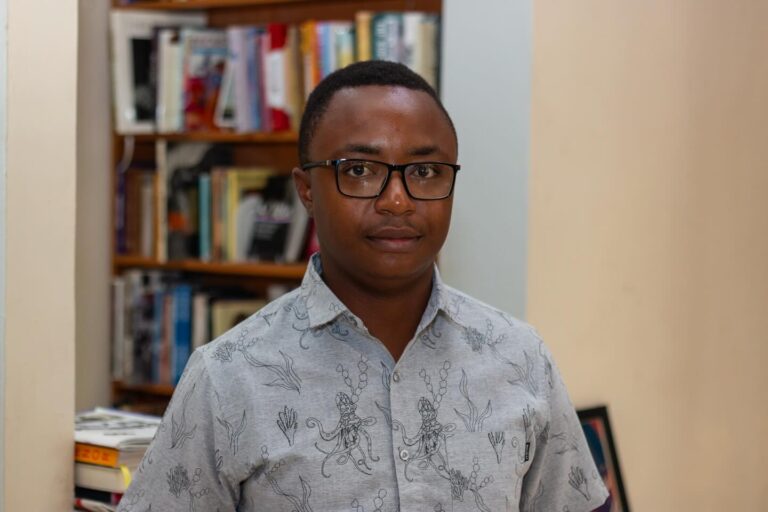

Zimbabwean writer Simbarashe Kundizeza has denied using artificial intelligence to write his short story “The Blue Fighter”, which won this year’s Caine Prize for African Writing.
His statement comes a week after he won the £10,000 prize and after an article in The Atlantic claimed AI-detection software had found his work to be entirely AI-generated.
The article, “Yet Another Prizewinner Seems to Be AI” by Vauhini Vara, said detection tool Pangram had shown that Kundizeza’s story – about a boy whose family falls on hard times – was generated by AI.
The accusation has caused an uproar on social media.
Ellah Wakatama, chair of the Caine Prize, told the BBC’s Front Row programme she was shocked that the magazine had not waited for a full investigation before publishing. She said she was contacted about the allegation on Friday and the article was published on Sunday.
“I do wish The Atlantic had spent more time investigating this so that alongside Pangram, they did have evidence of real human investigation before tainting the prize and tainting this winner,” she said.
Vara, who quoted Wakatama in her piece, said her wariness of Silicon Valley was “well founded and reasonable”, but that Pangram’s internal research showed its assessments were rarely wrong.
The case follows disputes over other literary prizes this year, including the Commonwealth Short Story Prize, which was won by Trinidadian writer Jamir Nazir despite allegations that he had used AI, and the withdrawal of Canadian-Haitian author Thelyson Orelien from France’s Goncourt prize over AI allegations, which he denies.
The backlash to The Atlantic article has included criticism from African writers, with some suggesting such accusations are disproportionately aimed at non-white writers.
Wale Lawal, the Nigerian founder of “The Republic”” magazine, described the article as “crazy, racist and wildly unethical”.
Zimbabwean writer Joe Ruzvidzo, whose novel “Welcome to Anywhere” was published last year, said he stood by Kundizeza and that it was time “to fight this literary stop-and-frisk”.
Nigerian publisher Modupe Daramola said it was necessary to discuss how “these AI allegations are targeting Black and African writers” and how they were often disproportionately scrutinised.
Wakatama said the Caine Prize is conducting an internal investigation. Kundizeza will submit documentation of his various drafts, and there have been ongoing conversations with all the judges and with “The Shallow Tales Review”, which first published “The Blue Fighter” in 2025.
In a statement posted on X, Kundizeza said he had a “concrete, documented history” of the story’s development and set out its chronology.
“I would like to say at the outset that this statement is not in any way a proffer of an explanation or a defense against the allegations levelled against me in the article published by The Atlantic, because I don’t believe the article warrants either,” he wrote.
“For the avoidance of doubt, I wrote “The Blue Fighter”. I did not use generative AI to write it. It is entirely my own work.”
He said the story’s genesis was during his LOATAD Black Atlantic Residency in Ghana, where he read a poem by Vangile Gantsho titled “My Father’s Hands”.
He said the story inspired him to write about his family’s experiences in Zimbabwe, including his father leaving his accounting profession and the hardships that followed, adding that other aspects of the story, including characters and setting, were drawn from his own life.
Kundizeza said he sent the first completed draft to Vangile for feedback on 15 May 2025, submitted it to “The Shallow Tales Review” on 27 May, and it was accepted by fiction editor Nzube Nlebedim on 10 June. he said both Vangile and Nzube provided editorial feedback on 25 June.
He said on 27 June, he sent the final draft, asking that the formatting of an epigraph be preserved as a courtesy to Vangile. The story was published on 30 June 2025.
Addressing The Atlantic’s comparison of the style of “The Blue Fighter” with his earlier work, Kundizeza said writers do not work from a single fixed template.
“My debut novel ‘Freelance’ and the story ‘The Whistleblower’ published in ‘Transition Magazine’ in 2021, which is referenced by Ms Vara, are thrillers dealing with political intrigue”, he said.
“‘The Blue Fighter’, however, is a deeply personal story about economic collapse and familial relationships. The voice shifts because the subject matter demands it.”
He added that the motive for using AI made no sense, as he was not commissioned to write the story nor paid for its publication, and the decision to submit it for the Caine Prize was made by the editor of ‘The Shallow Tales Review’ months after publication.
“I therefore didn’t write the story with any guarantee that it would be submitted, let alone win anything,” he said.
“The Blue Fighter is my work, and I stand by it completely,” he added.
More: BBC News

 Pindula WhatsApp Channel
 Facebook Page


Leave a Reply