

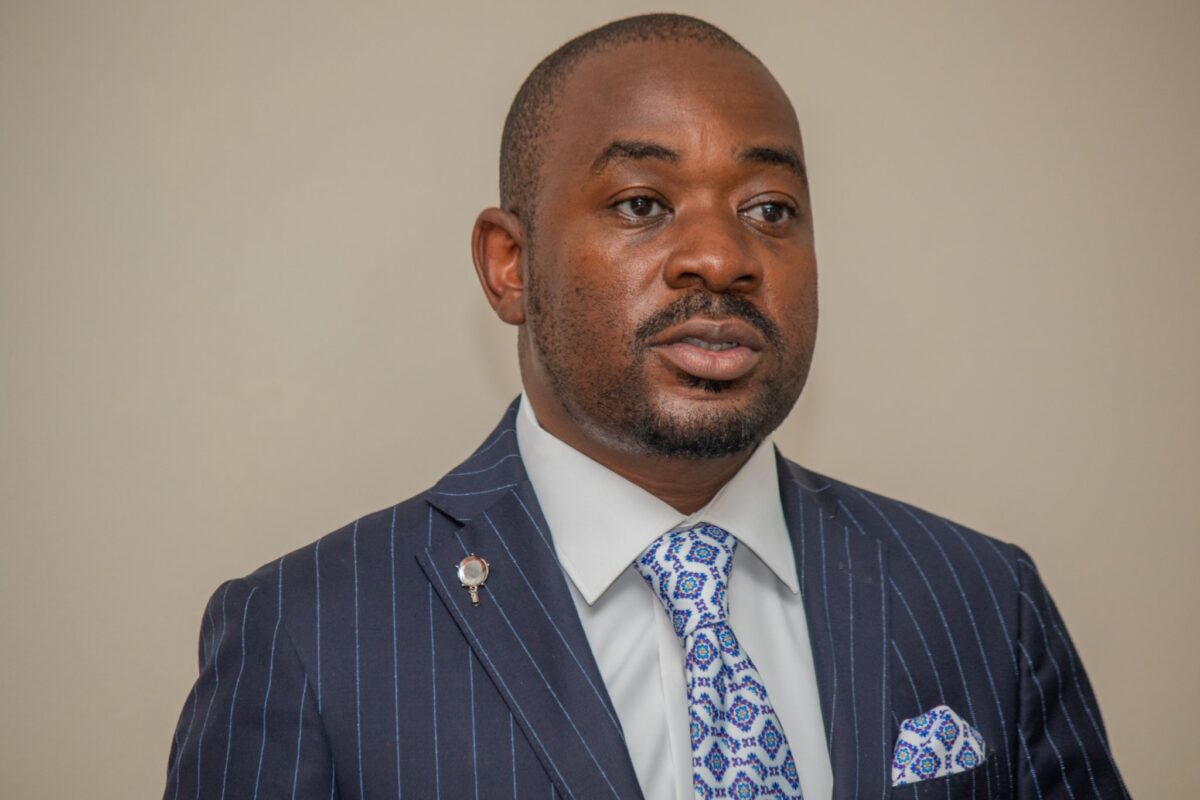

Zimbabwean opposition leader Nelson Chamisa on Friday marked the 27th anniversary of the founding of the Movement for Democratic Change (MDC), using the occasion to reflect candidly on the movement’s origins, its strategic missteps, and the long, often bruising road that has followed since its launch at Rufaro Stadium on 11 September 1999.
In a lengthy statement, Chamisa traced the party’s roots back beyond the stadium launch itself, to a nationwide consultative process that culminated in the National Working People’s Convention, held in Harare from 26 to 28 February 1999.
That gathering, he said, was convened by the Zimbabwe Congress of Trade Unions (ZCTU) together with representatives from more than 40 civic organisations.
“We were part of that historic process, representing students under the ZINASU banner,” Chamisa said, referring to the Zimbabwe National Students Union.
He said the convention “laid the groundwork and called for a vigorous alternative political movement,” which directly led to the formation of the MDC later that year.
Chamisa took over as MDC leader following the death of the party’s founding president, Morgan Richard Tsvangirai, in February 2018. He remained the party’s leader when it morphed into CCC in 2022.
He argued that there are important lessons in how the MDC came together — and, more significantly, in what preceded its formal announcement. Chief among these, he said, was that the MDC was originally conceived as a broad-based people’s movement rather than a conventional political party.
“In my considered view, the mistake was prematurely turning this great and glorious movement idea into a narrow political-party vehicle, essentially reducing ourselves to a parliamentary and local-authorities party, far removed from the original idea of conveying and midwifing real change in Zimbabwe,” he said.
Chamisa asserted that a range of organisations with differing interests had come together to form what he described as a “variegated movement,” united by the shared goal of ushering in a new political order in Zimbabwe.
Chamisa reflected on the sense of optimism that defined the movement’s early days, suggesting that few among its founding figures anticipated the struggle would still be ongoing nearly three decades later.
“At the launch of the MDC on 11 September 1999, if you had gone to Morgan Tsvangirai, Gibson Sibanda, or any of my colleagues in that stadium and told us that 27 years later, in 2026, we would still be fighting ZANU PF, we would probably have dismissed you or disciplined you!” he said. “We were so convinced it would be a walkover. A sprint. A walk in the park.”
In a more personal and light-hearted passage, Chamisa recounted a run-in with the late musician Simon “Chopper” Chimbetu at The Point Restaurant, on the corner of Third Street and Josiah Tongogara Avenue in Harare, known at the time for its Portuguese chicken and bar.
Chamisa said he had gone to the restaurant for lunch with the late Learnmore Jongwe when they encountered Chimbetu enjoying a beer in the company of Zimpapers journalist Munyaradzi Huni.
A heated exchange followed over Chimbetu’s song “Kuti kuState House Kure” (“State House is far”), which Chamisa and his colleagues at the time regarded as a jab at the democratic movement.
“We almost had a fight with Chimbetu because we were telling him he was counter-revolutionary for singing that song,” Chamisa recalled. “We were saying: ‘Iwe mudhara iwe, you say kuState House kure, iyo State House iri apo!’” — roughly translating to an insistence that State House was, in fact, within reach.
Chamisa said the episode was emblematic of the era’s political climate, where “cancel culture was huge,” recalling boycotts of performers — including musician Andy Brown — whom the movement regarded as sympathetic to the ruling party.
Looking back, Chamisa conceded that his confident prediction at the time had not aged well. “I was saying Chopper was sponsored by ZANU PF. Chopper was correct. Indeed, State House has been far,” he said.
Despite the admission, Chamisa struck a defiant and hopeful tone about the movement’s prospects, insisting that victory remains close at hand.
“And here we are, just around the corner. Almost there. We cannot have come this far not to arrive,” he said. “Arriving is the only logical conclusion. Having come this far, we will definitely get there.”
He described the enthusiasm of the movement’s youthful early years as a lesson in the realities of political struggle. “A struggle is not a picnic. It is not some romantic escapade where everything is honky-dory,” he said, warning that enthusiasm “can easily turn into disappointment, disillusionment and despondency” if not carefully guarded against.
“But we have chosen to defeat all that negativity and remain focused on the goal,” he said. “Democratic and citizenocratic victory in our lifetime remains our objective. And we will get there.”
Chamisa thanked Zimbabweans for their continued support and acknowledged the sacrifices made by those who have stood with the movement over nearly three decades.
“They have tried every trick to divide us and break us. But they have hardened us through three decades of struggle for real change and true freedom,” he said.
“Many have lost property, jobs and opportunities. Many have been killed. We have been abused, incarcerated and terrorised. We refuse to be compromised. We refuse to be swallowed.”

 Pindula WhatsApp Channel
 Facebook Page


Leave a Reply