



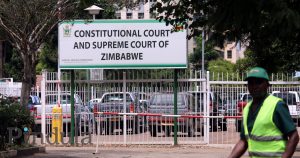
The Constitutional Court has overturned a landmark High Court ruling that had declared part of the Termination of Pregnancy Act unconstitutional and expanded abortion access for minors and victims of marital rape.
The country’s top court did not rule on whether the disputed provision is constitutional, leaving the substantive question of who qualifies for a lawful termination unresolved.
Instead, it ordered the High Court to hear the matter afresh, saying the original proceedings were not properly conducted and that critical arguments were never put before the lower court.
In a judgment handed down by Justice Ben Hlatshwayo, the Constitutional Court refused to confirm the High Court’s declaration of invalidity of 22 November 2024 and set aside the judgment in HH 552/24.
The case was brought by Women and Law in Southern Africa and Talent Forget, who challenged Section 2(1) of the Termination of Pregnancy Act.
They argued that the definition of “unlawful intercourse” is too narrow because it excludes pregnancies involving minors and pregnancies resulting from marital rape.
The High Court upheld the challenge and declared the provision unconstitutional. That ruling has now been wiped from the legal record.
Justice Hlatshwayo said the State parties – the Minister of Health and Child Care, the Attorney General and Parliament – had failed to properly take part in the original case, despite it raising issues of profound public importance.
The State had initially said it would abide by whatever decision the High Court made, rather than actively putting forward arguments and material.
The Constitutional Court said the case could not be treated like an ordinary private dispute because it involved constitutional questions affecting the public at large.
The court also rejected an attempt by the State to introduce a fresh position on marital rape at the confirmation stage. The State opposed the inclusion of marital rape as a ground for a lawful termination, but the court said confirmation proceedings cannot be used to raise arguments that were never properly argued before the High Court.
There was a further problem with the scope of the High Court’s order. The applicants had challenged Section 2(1) only to the extent that it excluded particular forms of unlawful intercourse, but the High Court struck down the entire provision. The Constitutional Court found it had gone beyond the scope of the challenge.
Despite setting the ruling aside, the Constitutional Court upheld the applicants’ right to bring the case. It confirmed they had standing under Section 85(1)(d) of the Constitution, which allows individuals to approach the courts in the public interest, and said they were entitled to litigate on behalf of vulnerable groups.
Forget had told the court she became pregnant while still a minor in 2014. The court found her reliance on the later legal position on children was misplaced, as the law at the time defined a young person as someone under 16, but said that did not undermine the applicants’ broader public-interest standing.
The High Court can also consider appointing amici curiae, friends of the court, to assist with the complex constitutional issues.
The matter will now go back to the High Court for a fresh hearing. For now, neither side has won the substantive constitutional battle. The High Court must start again and decide whether Section 2(1) as it stands passes constitutional muster.
The Constitutional Court made no order as to costs, but warned that in future public-law litigation, parties whose conduct renders constitutional proceedings ineffective could face costs orders.
More: The Herald

 Pindula WhatsApp Channel
 Facebook Page


Leave a Reply