



United Zimbabwe Alliance (UZA) president Elisabeth Valerio has criticised the government’s abrupt ban on secondhand clothing and night-time vending in Zimbabwe’s Central Business Districts (CBDs), calling the move “dangerous and shortsighted.”
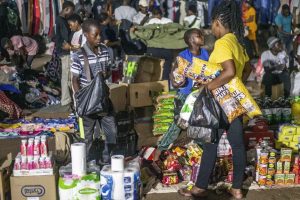
Her remarks come in response to a directive issued on Monday, 4 August 2025, by Local Government Minister Daniel Garwe, who ordered urban councils to immediately prohibit the importation and sale of secondhand clothes, as well as street and night vending activities.
Valerio, however, warned that the policy fails to consider the economic realities faced by millions of Zimbabweans. She said:
Places like Mupedzanhamo clothed many of our people. Sakubva Musika has been the lifeline and business hub for countless families.
From Chinhoyi rank market to Masvingo, Kwekwe, Kadoma, Chegutu and all other towns across Zimbabwe – secondhand clothing and vending have sustained livelihoods for decades.
To suddenly cut off these avenues without addressing the root causes is not only unfair – it’s dangerous and shortsighted.
She argued that informal trading is not a matter of choice but of necessity, driven by high unemployment and low incomes. Said Valerio:
We cannot legislate away poverty. Any law that does not take into account chikonzero chaita musoro uteme is bound to push people into even more informal and unregulated spaces.
We are not solving a problem – we are shifting it and likely intensifying the desperation. Poverty makes crime more likely as economically deprived people may turn to crime as a means of survival!
The UZA leader urged the government to adopt a more empathetic and realistic approach to informal trade.
She called for gradual integration of informal traders, skills development, and revival of the local textile industry before implementing bans. Sad Valerio:
Our economy has not yet recovered enough to absorb the informal sector into formal employment. The unemployment rate remains high, and incomes are low.
This is the reason why people turn to secondhand clothes – not because they do not love new things, but because they cannot afford them.
That’s the reality. It is not a matter of choice but of necessity. When we clamp down on informal traders without giving them alternatives, we are telling families to stop eating before we’ve provided a way for them to procure food.
We are telling a mother to stop selling tomatoes before she finds an alternate income stream. That is not policy – that is cruelty masked as governance…
We can’t pretend that everyone has a job or a stable source of income. Before we criminalise survival strategies, let us ask why people are in survival mode in the first place?
Why not open up avenues for the revival of our textile industries and make affordable, locally manufactured products available to the market before depriving our enterprising citizens of their livelihoods?
Why not create jobs first before robbing our people of their bread and butter!
Valerio said informal traders shouldn’t be banned overnight, but need to be gradually integrated into formal spaces, with proper support like skills training, access to capital, and affordable workspaces before anyone talks about making vending a crime. She said:
Let us demand that our policies be rooted in the lives of the people, not just theories drafted in boardrooms.
We cannot keep chasing symptoms while ignoring the root causes. Zimbabweans deserve dignity, not punishment.
Let us be the kind of Government that listens, understands, and acts with compassion.

 Pindula WhatsApp Channel
 Facebook Page


Leave a Reply