

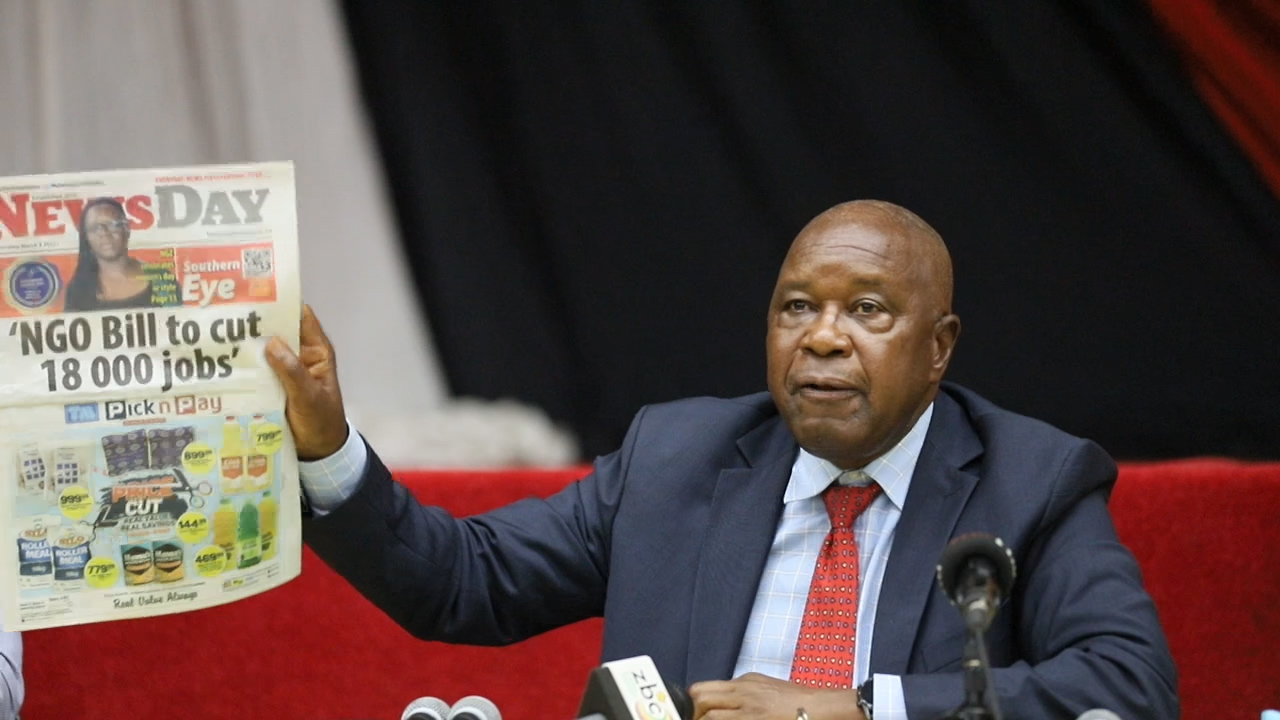

Former ZANU PF Mashonaland West chairman Temba Mliswa has accused party spokesperson Christopher Mutsvangwa of manipulating internal party processes and hiding behind party rules to pursue personal ambitions of one day leading ZANU PF.
Posting on X, Mliswa claimed that Mutsvangwa sees Vice President Constantino Chiwenga and businessman Kudakwashe Tagwirei as major obstacles to his political aspirations.
He alleged that Mutsvangwa’s recent vocal opposition to Tagwirei’s co-option into the ZANU PF Central Committee is less about party regulations and more about sidelining perceived rivals. Said Mliswa:
Mutsvangwa harbours ambitions of being Zanu PF leader and sees both VP Chiwenga and Tagwirei as stumbling blocks to the realisation of that dream.
The spirited press conferences against Tagwirei are an opportune moment for him to decimate the figure of one of his supposed opponents.
The party’s rejection of Harare Province’s recommendation to co-opt Tagwirei into the Central Committee has been a subject of heated discussion.
Mutsvangwa publicly stated that Tagwirei did not meet the requirements for Central Committee membership, citing the party constitution. But Mliswa argues that this reasoning is disingenuous.
He explained that the ZANU PF Politburo has the authority to grant waivers to candidates who may not meet the five-year minimum service requirement at provincial or DCC level if their strategic value, loyalty, and contributions to the party are deemed significant. Wrote Mliswa:
No one can argue against Tagwirei as lacking any of the above values for ZANU PF!
It is thus merely convenient lies for Mutsvangwa to cite the party law book as the hindrance against Tagwirei. It’s not!
The hindrance is his own ambitions which he feels Chiwenga and Tagwirei are endangering and he has to act to scupper them in whichever way!
Mliswa further accused Mutsvangwa of political opportunism, alleging a history of undermining colleagues to advance himself.
He cited previous incidents, including Mutsvangwa’s role in the ouster of former Vice President Joice Mujuru and War Veterans leader Jabulani Sibanda, as examples of what he described as a pattern of self-serving political manoeuvres. Said Mliswa:
Mugabe died with regret for being misled by figures like Mutsvangwa, who instigated the expulsion of Mai Mujuru under the false pretense that she sought to usurp power. Such underhanded tactics are emblematic of Mutsvangwa’s political modus operandi.
He exhibited the same when Jabulani Sibanda, then War Vets leader, was ousted for raising legitimate concerns within the party. Mutsvangwa seized the opportunity to ascend as the leader of the War Veterans in 2014.
He also downplayed Mutsvangwa’s political credentials, claiming he often distances himself during periods of turmoil, only to resurface and claim credit when the dust settles. Said Mliswa:
In terms of substantive political credentials, Mutsvangwa is notably deficient, often resurfacing only at crucial junctures to claim accolades for outcomes achieved by others. This pattern was evident during the 2017 campaign for Restore Legacy.
While some of us diligently worked to build support both in Parliament and across various international platforms, he retreated from visibility. This is well-documented. When the situation became untenable, he abandoned his fellow War Veterans, who faced harassment.
In his absence; remarkably, fellow War Veterans, the likes of Matemadanda and Mahiya exhibited greater resilience to push through the campaign. He resurfaced when it was calmer.
On the Tagwirei issue, Mliswa argued that it would be hypocritical for ZANU PF to benefit from the businessman’s financial support, while denying him meaningful participation in party structures. He said:
It would be the height of irony and perhaps a bit of injustice for the party to bask in the glow of Tagwirei’s generosity, as the likes of Mutsvangwa have been doing, while simultaneously blocking him from inclusion in the party’s hierarchy.
He suggested ZANU PF should consider adopting a model similar to South Africa’s ANC, which owns businesses to fund its operations, thereby reducing dependency on individual financiers like Tagwirei.
Mliswa’s remarks come amid growing speculation about succession dynamics within the ruling party ahead of its 2027 elective congress.
 Pindula WhatsApp Channel
 Facebook Page


Leave a Reply