





Zimbabwe’s Apostolic Faith Mission (AFM), one of the country’s largest and oldest Pentecostal churches, has existed as two legally distinct churches since 2021.
There is the AFM in Zimbabwe, led by Reverend Amon Dubie Madawo, and the AFM of Zimbabwe, led by Reverend Cossam Chiangwa. Both claim to be the true continuation of the mother church, but the courts have treated them as separate entities since the Supreme Court ruling of 28 May 2021.
The battle to control AFM started in 2018. The then-President, Reverend Aspher Madziyire, fell out with his then deputy, Reverend Chiangwa, over proposed amendments to the church constitution.
The Madziyire camp was accused of tinkering with the constitution to defer elections and extend the executive’s stay in power. In response, Chiangwa, together with the national workers’ council, passed a vote of no confidence against Madziyire and his administration in September 2018.
Madziyire approached the High Court to nullify the outcome. In September 2019, the High Court ruled in favour of Madziyire and declared him the bona fide leader. Chiangwa appealed to the Supreme Court.
While the battle dragged on, Madawo succeeded Madziyire as President of the AFM in Zimbabwe side.
On 28 May 2021, the Supreme Court brought finality. It upheld the 2019 High Court ruling that gave Madawo full control of the denomination, its assets and symbols. The court found Chiangwa was not the legitimate leader, had no locus standi, had effectively seceded, and was obliged to return church properties.
After losing, the Chiangwa faction officially launched its own splinter church. The new church is called the AFM of Zimbabwe to differentiate it from the existing AFM in Zimbabwe led by Madawo.
The new church introduced a logo similar to the one used by AFM in Zimbabwe but with reversed colour schemes and laterally inverted symbols, claiming it remained part of AFM International and therefore entitled to use the logo. It was barred from using properties and assets of the AFM in Zimbabwe and announced alternative venues for services.
Since then the two factions have fought over church properties and over trademark use, with Madawo’s side seeking to bar Chiangwa from using the AFM logo.
While the Chiangwa-led AFM OF Zimbabwe has received no support from the government, the Madawo-led AFM IN Zimbabwe has moved into the orbit of the State.
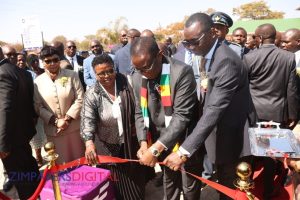
Last week, President Emmerson Mnangagwa officially opened the AFM IN Zimbabwe’s Vineyard Assembly in Knowe, Norton, an event presented as a milestone for the church’s expansion.
At that event, President Mnangagwa unveiled the commemorative plaque and handed over 3 vehicles to be used by church officials.
Madawo publicly thanked the President, saying his donations towards the completion of the AFM Vineyard Assembly were transformative.
Speaking during the official opening, Madawo said the President had donated cash, a 30-seater bus, an SUV and double-cab vehicles.
Madawo publicly declared his allegiance to the ruling ZANU PF party, reigniting debate over the political neutrality of religious leaders.
His declaration came at a time when ZANU PF is campaigning to extend President Mnangagwa’s stay in office to 2037.
The Chiangwa faction, by contrast, has remained outside state patronage and continues to operate from alternative venues, fighting its own internal battles.
The current High Court case nullifying Chiangwa’s presidium over the unlawful raising of the candidate age limit from 65 to 70 is an internal dispute within the AFM of Zimbabwe itself, not involving the Madawo side.
The result is a church split that began as a constitutional argument in 2018 and has now become a study in two different models of survival in Zimbabwe.
While one is seeking legitimacy through the courts and independence from the state, the other has secured it through the courts, state donations and declared loyalty to ZANU PF.






Leave a Reply Cancel reply