




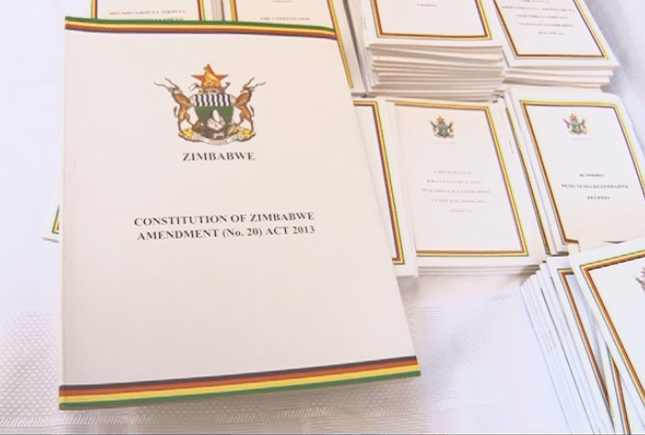


The government gazetted the draft Constitutional Amendment No. 3 Bill on Monday, 16 February 2026.
The proposed amendment would allow President Emmerson Mnangagwa to extend his current term and alter the process by which leaders are elected
Parliament will now open 90 days for public debate, after which the Bill will be formally tabled for consideration. Below is the gazette:
CONSTITUTION OF ZIMBABWE AMENDMENT (No. 3)
CONSTITUTION OF ZIMBABWE (AMENDMENT) BILL, 2026
MEMORANDUM
This Bill introduces a set of constructive reforms that, taken together, reinforce constitutional governance, strengthen democratic structures, clarify institutional mandates, and harmonise Zimbabwe’s constitutional order with tested and successful practices in other progressive jurisdictions.
The Bill modernises and streamlines various aspects of the constitutional architecture while upholding the values of the 2013 Constitution.
The amendments form part of a broader constitutional evolution, one that is grounded in the deliberate refinement of governance frameworks and an increased focus on institutional efficiency, political inclusivity, and long-term national stability.
It must be reiterated that many of the reforms incorporated into this Bill align Zimbabwe with contemporary African constitutional standards that have proven to be effective, resilient, and widely respected.
In detail, the Bill provides as follows—
Clause 1
This clause provides the short title of the Bill.Clause 2
This clause transfers the responsibility for registering voters, compiling the voters’ roll, and maintaining the voters’ roll and registers from the Zimbabwe Electoral Commission to the Registrar-General. The rationale ensures efficiency since the Registrar-General is the custodian of these records.Clause 3
This amendment establishes a parliamentary method for selecting the President. It specifies that a candidate must secure a majority of votes, and if no one achieves an absolute majority, a run-off election will be held. The process is overseen by the Zimbabwe Electoral Commission to ensure it is conducted properly. These measures strengthen constitutional accountability by promoting fairness, openness and judicial oversight in the election. The procedure for the election shall be in accordance with Standing Rules and Orders of Parliament.Clauses 4, 9, 10
To eliminate election mode toxicity and allow sufficient time for project implementation while promoting stability, these clauses aim to substitute the current five-year term with a seven-year term as provided in sections 95, 143 and 158 of the Constitution.Clause 5
This clause provides for the deletion of the word “first” before “Vice President”. This concept was repealed by constitutional amendment number 2.Clause 6
This clause stipulates that the provisions of section 92 shall take effect if the President-elect passes away, resigns or is removed from Office.Clause 7
This clause removes the words “High Court” and replaces them with “Supreme Court” since the Attorney General must be qualified for appointment as a judge of the Supreme Court.Clause 8
The provision allows the President to appoint ten (10) senators, raising the total number of senators to ninety (90). This amendment aims to bring in broader technical expertise, enhance parliamentary oversight, expand the pool of potential ministers, build public confidence, and help reduce political division.Clause 11
The clause provides for the creation of a Zimbabwe Electoral Delimitation Commission. It addresses the concerns about ZEC’s dual role in drawing electoral boundaries and promotes good governance and institutional integrity.Clause 12
This clause deletes the Zimbabwe Electoral Commission and substitutes it with the Zimbabwe Electoral Delimitation Commission, as the function for delimitation of boundaries is now within the ambit of the Zimbabwe Delimitation Commission.Clause 13
This clause deletes the Zimbabwe Electoral Commission and substitutes it with the Zimbabwe Electoral Delimitation Commission in various parts of the section, as the function for delimitation of boundaries is now within the ambit of the Zimbabwe Delimitation Commission.Clause 14
This clause provides for the Constitutional Court to hear any other matter on a new law of public importance. Currently, the Constitutional Court is only permitted to hear cases of constitutional matters and presidential elections.Clause 15
This clause repeals section 183(3), (4), (4a) and (5) and substitutes it with the amended Judges under section 189, the Judicial Service Commission.Clause 16
This clause amends section 212 (Functions of Defence Forces) of the Constitution by deleting the words “to uphold this Constitution” and substituting them with “in accordance with the Constitution”. The amendment is intended to reinforce the provisions of sections 213 and 214 of the Constitution.Clause 17
This clause proposes repealing section 239(c) to (e) so that the functions can be reassigned to the Registrar-General, and section 239(f) so that its function is transferred to the Zimbabwe Electoral Delimitation Commission.Clause 18
This clause repeals Part 4 of Chapter 12 of the Constitution, which establishes the Zimbabwe Gender Commission. Its functions will be transferred to the Zimbabwe Human Rights Commission (ZHRC), since the ZHRC is already mandated to protect all human rights, including those that are currently under the purview of the Zimbabwe Gender Commission.Clause 19
This clause inserts the Zimbabwe Gender Commission function under the Zimbabwe Human Rights Commission.Clause 20
This clause removes the requirement for the President to appoint the Prosecutor-General on the advice of the Judicial Service Commission, as such an arrangement creates a potential conflict of interest where the Commission recommends a candidate for appointment.Clause 21
This clause repeals section 281(2). It violates the political rights of traditional leaders. Their code of conduct shall be provided in an Act of Parliament.Clause 22
This clause repeals Part 5 of Chapter 12 of the Constitution (National Peace and Reconciliation Commission).







Leave a Reply Cancel reply