





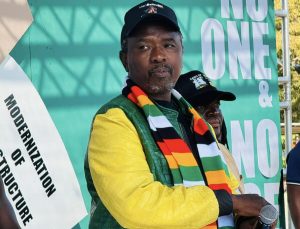
A recent speech by former Army General and now Sports Minister, Anselem Nhamo Sanyatwe, publicly praising businessman Kuda Tagwirei has ignited a fresh wave of speculation and critical analysis regarding the ongoing power dynamics within ZANU PF and the party’s succession matrix.
Political commentator Brighton Mutebuka suggests the comments carry significant weight, particularly concerning Vice President Constantino Chiwenga’s presidential ambitions.
Sanyatwe’s remarks, delivered at an unspecified public event, unmistakably lauded Tagwirei for his alleged pivotal role during the period of debilitating Western sanctions imposed on Robert Mugabe’s regime due to alleged human rights violations and controversial land expropriations.
The Sports Minister’s speech also credited Tagwirei with funding the contentious “Command Agriculture” programme, which Mutebuka says is “renowned for facilitating grand looting of government funds by high ranking government, ZANU PF & military officials amongst other things.”
Furthermore, Sanyatwe’s address shed light on Tagwirei’s previously undisclosed financial contributions to other government functions, effectively casting the businessman as a “saviour” during a time when the state was reportedly “practically bankrupt.”
Crucially, Sanyatwe also declared that Tagwirei “respects” the military, a statement Mutebuka deems “highly significant” in the current political climate.
Mutebuka argues that despite Sanyatwe’s reassignment from the powerful post of Commander of the Zimbabwe National Army, widely perceived as a demotion, he is still considered Vice President Chiwenga’s “right-hand man.”
With Chiwenga currently embroiled in a “vicious power struggle for the presidency with the incumbent,” President Emmerson Mnangagwa, Mutebuka posits that Tagwirei is being “conveniently & strategically catapulted into prime position to scuttle Chiwenga’s own presidential ambitions.”
The commentator suggests that Sanyatwe’s “fawning adoration” of Tagwirei has set “tongues wagging,” leaving many to question whether this represents an “unlikely betrayal of Chiwenga by Sanyatwe” or merely “high stakes elite political poker gamesmanship / manoeuvring to wrongfoot ED.”
Should it be a betrayal, Mutebuka believes it would be a “monumental setback for Chiwenga,” who is currently employing a “hear-no-evil-see-no-evil-respond-to-no evil strategy” in the power struggle.
Conversely, if it is a strategic manoeuvre, he contends it has been “deftly deployed” due to its capacity to “confuse and confound many across the political spectrum.”
While acknowledging the complexity of the question, Mutebuka believes it is “unlikely that he can overhaul Chiwenga in the home straight to claim the highly coveted ‘prize’.”
He describes the “Tagwirei phenomenon” as akin to “political ‘overreaching’,” appearing “too little too late” and borne out of “political desperation.”
Mutebuka asserts that Tagwirei seemingly “lacks the required political minerals for his wretched assignment,” contrasting “formalistic perfunctory ‘respect’” with the “hard knuckle, hard iron, aura coated ‘respect’” vital in African politics.
Mutebuka forecasts that despite Tagwirei and President Mnangagwa commanding a “huge war chest,” the “battle will go right down to the wire & will be fraught with danger.”
He suggests Tagwirei suffers from an “irredeemably suffocating deficit” in this high-stakes environment.
The commentator says the current “choreography” involving Tagwirei exhibits a “decided whiff of being unhinged, garrulous, pantomime villain vibes,” creating a “yawning gap between that and what’s required to run the affairs of the state.”
Mutebuka expresses a “foreboding & ominous feeling that a time, a moment shall arrive when all the faffing about we are witnessing now will end – and the real final battle will then commence in earnest.”
Beyond the internal power struggles, Mutebuka reiterates Zimbabwe’s fundamental need for “a competent, democratic, legitimate & credible government elected in free and fair elections that focus on good governance and is steeped in the rule of law,” a goal he sadly deems a “pipe dream.”
He warns that the country is “caught between a rock and a hard place – a potential dynasty and another suffocating dictatorship,” unless Chiwenga, if triumphant, undergoes a “damascene moment and embraces democracy,” or champions a government of national unity.
Mutebuka argues that President Mnangagwa’s government remains “illegitimate,” born from “sham elections” as per SADC’s SEOM Final Report, and consequently, any succeeding government will also require “curing” from this inherent illegitimacy.





Leave a Reply Cancel reply